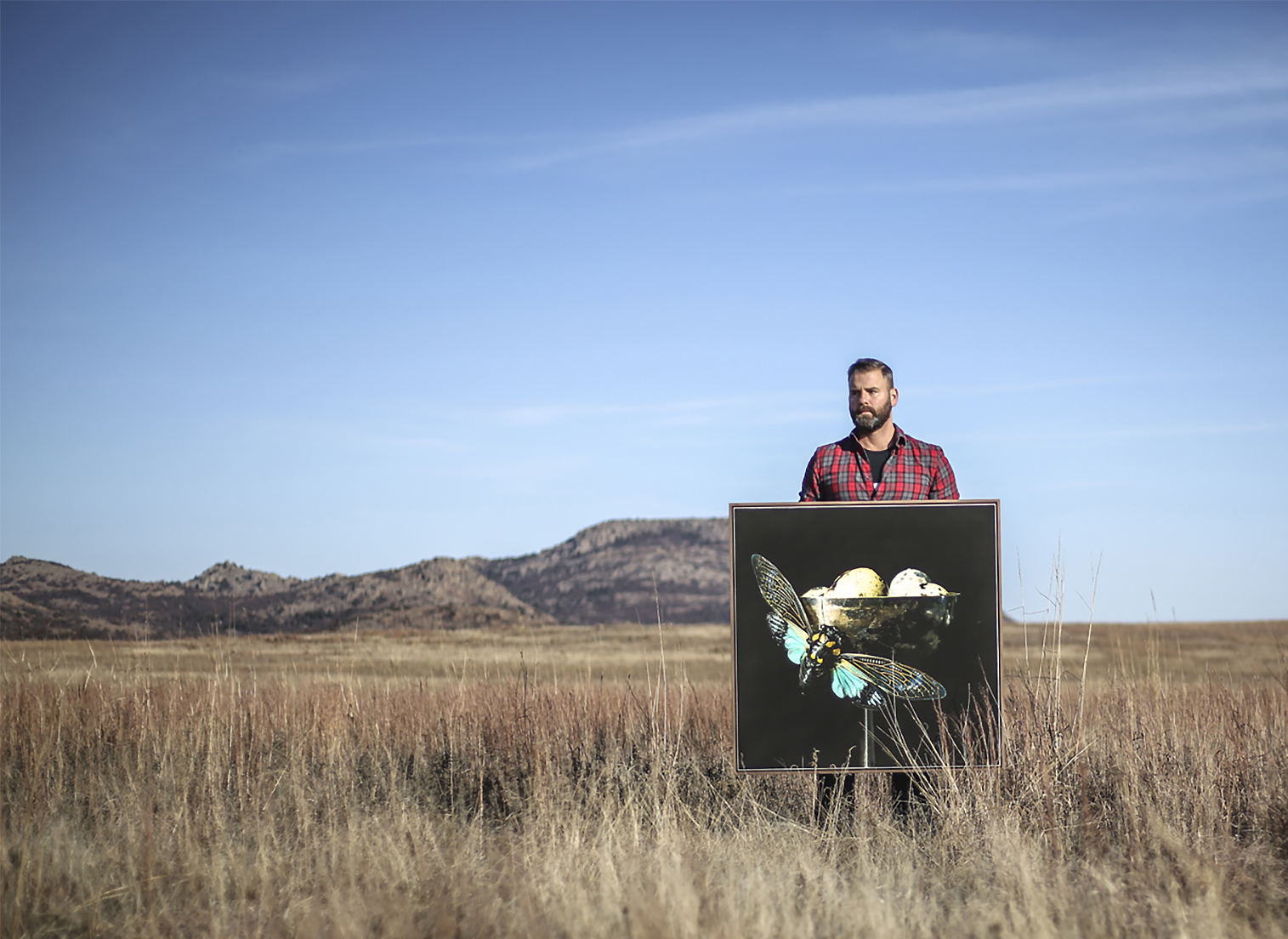
Curtis Speer is an artist and photographer raised in Lawton, Oklahoma. Being raised in a small town, he began to pay closer attention to his surroundings at an early age. With a copious amount of self-prescribed solitude, he would spend time outside, far away from anyone. There he tuned into the colors, sounds and most importantly, the light. He enjoys creating bodies of work that play with the mind and the eyes. Curtis finishes off his work in handcrafted raw walnut frames and hand finishes the edges of his images so the final piece is a work of art, not just another photograph. .
Curtis has worked across the United States, from the west coast to firms in New York. Throughout his career, he has worked for brands like Neiman Marcus, Williams-Sonoma, Pottery Barn, and Nike. His works of art are featured in galleries and museums throughout North America. Get to know Curtis Speer a little better in our intimate interview.
How are you doing today?
All is well with me here in New England. Working on my new line of wallpaper designs that I started over a year ago.
Regarding your gallery, any particular theme or focus? How do you choose what goes into your gallery?
In my tenth and final year, I moved the gallery to the heart of Newport, RI. I named the gallery CUSP which is derived from my initials but to also represent a space that has a positive reference to artists who have done the work. The word “emerging” sounds like such a struggle, but CUSP has power. This is my last year as a gallery owner and I have decided to bring in two new artists to have exhibits this final season, Tracey Weisman, “Some Birthday, America” and Mark Schianca, ‘Summer Sampler” alongside my own works. This year, we push boundaries especially during this transition that our country is experiencing. I want to be provocative, contemplative, uncomfortable.
Can you describe the first time when you realized that creating was something you absolutely had to do?
I don’t remember a single dramatic moment when a switch flipped — it was quieter than that, but relentless. From a very young age, creating wasn’t something I did; it was something that happened to me. Drawing, making, arranging, observing — those acts felt less like hobbies and more like a form of breathing. When I wasn’t creating, something felt off, like a tension I couldn’t quite name.
The real realization came later, when I tried to imagine a life without it. I could do other things. I could be productive, successful, even comfortable — but without creating, everything felt flattened. Color dulled. Curiosity faded. I realized that making wasn’t about ambition or career; it was about survival. It was how I processed the world, how I made sense of beauty, chaos, grief, joy, and contradiction.
There was also a deep sense of necessity — almost obligation. I became aware that if I didn’t create, something would be lost, not just for me, but in the exchange between myself and the world. Creating became a way of participating in life rather than observing it from a distance. It allowed me to translate experience into something shared.
That’s when I understood: this wasn’t optional. Creating was the thread that connected who I was, how I saw, and how I lived. Everything else — career, medium, recognition — came later. The need came first, and it never left.
How has growing up in Oklahoma inspired your work and your outlook?
Growing up in Oklahoma shaped me in ways I didn’t fully understand until I left it. There’s a vastness there — of land, sky, and silence — that teaches you to pay attention. You learn how to sit with space, how to notice small shifts in light, weather, and mood. That sensitivity to atmosphere and nuance has stayed with me and continues to influence how I see and create.
Oklahoma also instilled a deep sense of resilience and humility. It’s a place where people work hard, often without recognition, and where creativity isn’t always encouraged as a viable path — which meant that making art felt both private and essential. I learned early on how to create without permission, how to trust my inner voice even when there wasn’t an obvious audience for it.
There’s an emotional honesty to growing up there as well. Life isn’t overly curated or romanticized — it’s direct, sometimes raw, sometimes tender. That grounded realism shows up in my work through restraint, restraint, and emotional clarity. I’m drawn to moments that feel quiet but charged, beautiful but slightly uneasy — a reflection of living in a place where simplicity and complexity coexist.
Most importantly, Oklahoma gave me a strong sense of identity. No matter where my career has taken me, that early experience taught me the value of authenticity, community, and staying rooted while reaching outward. It’s the foundation I return to again and again — a reminder that clarity often comes from wide open spaces and honest beginnings.
How has being gay impacted your experience both creating and working as an artist? I’m sure things have evolved a lot in the 20 years you’ve been out.
Being gay has profoundly shaped both how I create and how I move through the world as an artist — especially over the past twenty years. Early on, it meant learning how to see from the margins. Before I ever named it as identity, queerness gave me an acute awareness of subtext, of what’s spoken and what’s withheld, of how people perform safety or authenticity depending on the room. That sensitivity became a quiet education in observation, empathy, and emotional nuance — all of which deeply inform my work.
For a long time, being out required courage that extended beyond personal life into professional space. There was an unspoken calculus: when to soften, when to stay quiet, when visibility might cost opportunity. That tension — between visibility and protection — sharpened my understanding of vulnerability and power. It also reinforced the importance of creating work that felt honest, even when it wasn’t easily categorized or universally comfortable.
As the world has evolved, so has my experience. There’s far more space now for queer voices, narratives, and leadership in the arts, and that shift has been meaningful. But what’s stayed consistent is the role queerness plays in my creative lens. It has given me permission to exist in the in-between — to resist binaries, to embrace ambiguity, and to question dominant narratives rather than accept them at face value. That perspective lives in my work’s quiet tension, its emotional restraint, and its refusal to explain itself too neatly.
Being gay has also shaped how I show up for other artists. I understand how transformative it can be to feel seen, safe, and supported — especially early on. That awareness fuels my commitment to building inclusive spaces where artists don’t have to edit themselves to belong.
Ultimately, queerness isn’t a theme I apply to my work — it’s a way of seeing. It’s taught me that identity is layered, that beauty can be subversive, and that authenticity is both a risk and a responsibility. Over the past twenty years, I’ve learned that being fully myself — in life and in art — isn’t just possible; it’s essential.
Your study series with the men on the beach is interesting. Each piece says something about masculinity or the male body. I appreciated that there wasn’t forced sexuality. You focus on light a lot in your work. And feature the sky and water quite a bit. Both play with light in interesting ways. Can you talk about that?
I’m really glad you picked up on that, because it’s very intentional.
That series came from a desire to look at masculinity without performance. So much imagery of the male body — especially in beach settings — leans immediately into spectacle, dominance, or overt sexuality. I wasn’t interested in that. I wanted to create space for masculinity that feels human, unguarded, and momentary. The men in those images aren’t posing for the viewer; they’re existing within a larger environment. That shift alone changes the conversation.
The absence of forced sexuality is important to me. I’m far more interested in vulnerability than provocation. Strength, to me, shows up in stillness, uncertainty, introspection — in bodies that are relaxed rather than flexed, present rather than performing. By allowing the figures to be quiet, the work opens up room for viewers to project their own understanding of masculinity onto the image, rather than being told what to feel.
Light is really the unspoken subject of that series — and of much of my work. Light reveals, but it also softens. On skin, it becomes emotional. It dissolves edges, removes hierarchy, and levels the body with its surroundings. I use light as a way to strip away narrative shortcuts. When the light is doing the talking, the image becomes less about identity labels and more about presence.
The sky and water are natural collaborators in that process. Both are reflective, unstable, and constantly shifting. They hold light without owning it. They mirror the internal states I’m interested in — flux, openness, uncertainty. Against those elements, the body feels temporary, vulnerable, and beautifully ordinary. That relationship keeps the work from becoming about control or conquest, which are ideas often attached to masculinity.
Ultimately, that series is about allowing the male body to exist without explanation. Not eroticized, not heroicized — just there. Light, sky, and water help create that neutrality, that pause. And in that pause, I think something more honest about masculinity has room to surface.
What are some of your favorite pieces you’ve created? Anything you’d like to do but haven’t?Choosing favorites is always tricky — it’s like picking favorite memories. But certain pieces stand out because they marked a shift in my thinking or practice. For example, the beach study series we discussed was deeply formative; it forced me to wrestle with vulnerability, light, and presence in ways I hadn’t before. Similarly, some of my fine art photography exploring mushrooms and natural decay — seemingly small subjects — taught me how to find the extraordinary in what most people overlook. Those works continue to surprise me with how much they reveal about perception, time, and attention.
Another favorite type of work is my color and fabric installations in the forest. Those pieces are immersive, ephemeral, and collaborative in spirit, and they’ve given me a new vocabulary for how art can interact with environment and audience simultaneously. Experiencing the public’s wonder and curiosity in real time is incredibly rewarding.
As for things I haven’t done yet, there are many directions I’d like to explore. I’m drawn to multi-sensory experiences that combine sound, projection, and light with photography — a way to make images exist more like experiences than static objects. I’m also interested in large-scale public art that engages community in a deeper way, beyond the walls of a gallery. And personally, I’d love to create a body of work that’s even more abstract — moving away from any literal references — just pure form, color, and emotion.
Ultimately, what excites me most is the tension between what I’ve done and what I haven’t. The unanswered questions, the projects still waiting to take shape, are what keep me in the studio, and keep me exploring new ways to make viewers feel, notice, or reflect. Every new piece is a conversation with both the past and the possibilities ahead.
Some of your work is pretty dark both literally and figuratively. Do you find the process of creating healing or therapeutic?
Absolutely — and I think that’s something people often sense even if they can’t articulate it. For me, creating is deeply meditative, almost like a conversation with the parts of myself that don’t have a voice elsewhere. The work can be dark — in tone, subject, or emotion — because life is dark sometimes. Ignoring that complexity would make the work feel shallow or inauthentic. But engaging with it through creation transforms it. It’s not catharsis in a dramatic, purging way; it’s more subtle — like processing, naming, and understanding.
The act of making allows me to slow down, to see patterns, textures, light and shadow — literally and metaphorically. Even when a piece deals with weighty or challenging themes, the process itself is grounding. Light, composition, detail — all of these decisions demand presence. You can’t create a nuanced image while distracted or closed off.
At the same time, it’s a kind of therapy that doesn’t rely on words. It’s about translating internal tension, grief, or uncertainty into visual language that others can encounter, reflect on, or even feel mirrored by. In that sense, art becomes a bridge — both for myself and for those who engage with it. The darkness doesn’t disappear, but it’s transformed into something tangible, something shared, something that can hold space rather than weigh on it.
Creating is restorative, not because it removes struggle, but because it makes struggle visible, meaningful, and ultimately, shared.
Where is the best place for people to buy your work or support you?
The best way to acquire my work is to contact me through my website, curtisspeer.com or curtis@cuspgallery.com.
Follow Curtis through his website, gallery, or social media: